NCAJ logo

Main navigation

  • Justice Index
    • Overall Rankings
    • Attorney Access
    • Consumer Debt Litigation Index
    • Disability Access
    • Fines & Fees
    • Language Access
    • Self-Representation
  • Advocacy
    • Ability to Pay
    • A2J Scholarship Project
    • Access to Justice Summit
    • Fines and Fees
    • Language Access
    • Legal Empowerment
    • Sustainable Development Goals
    • Tracking Outcomes
  • About Us
    • Our Mission
    • Team
    • Board
    • Benefit for Justice 2025
    • Contact Us, Partner with Us
    • Policies
    • Fordham Partnership
    • International AtJ Forum 2025
  • News
  • Donate

NCAJ News & Events

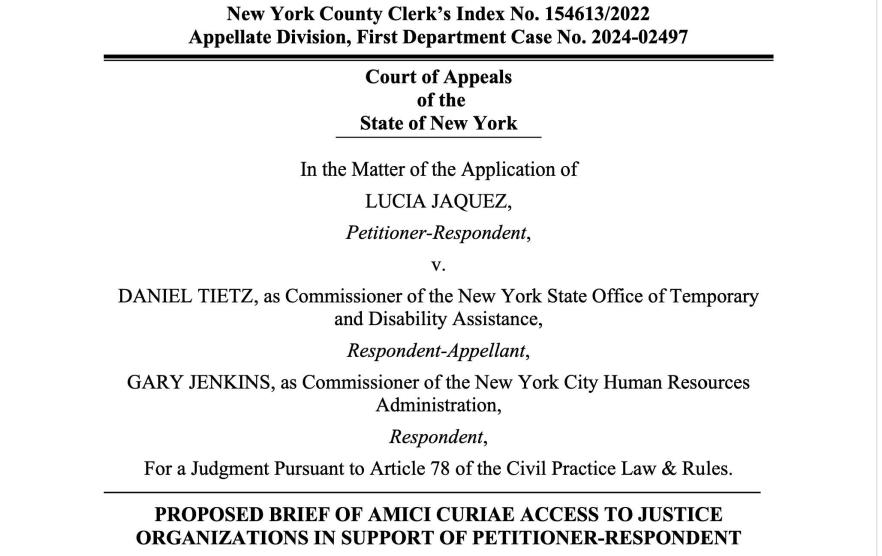
Jaquez Proposed Amicus Brief

NCAJ Files Proposed Amicus Brief Urging NY High Court to Uphold Catalyst Theory of Attorneys' Fees Recovery

October 6, 2026
This past week, NCAJ co-authored with WilmerHale a proposed amicus brief in Matter of Jaquez v. Tietz on behalf of NCAJ and two fellow amici. The brief urges New York's highest court to preserve the “catalyst theory” under New York's Equal Access to Justice Act (EAJA). Under the catalyst theory, a party may claim and recover attorneys’ fees under EAJA when the filing of a lawsuit serves as the catalyst that prompts the government to correct an agency error before a court reaches and decides the case on the merits. Catalyst fees are critical to EAJA's purpose because, without them, the government could avoid fee liability by correcting its error after a suit is filed, making lawyers less likely to take similar cases in the future. The amicus brief further explains that the value of representation is not only access, but also what access accomplishes: correction of the government's errors of law, and creation of incentives to reduce such errors by government in future cases. In these ways, the brief highlights the importance of catalyst fees in promoting the rule of law.
Read More
AI & AtJ

AI & Access to Justice Conference

March 30, 2026
Tens of millions of civil legal problems go unaddressed each year in the United States, while AI technologies are rapidly finding applications across virtually every domain of human endeavor. In this high velocity moment, the conference will examine how AI is being summoned to close the civil justice gap. Scholars, practitioners, reformers, and technologists will convene for public conversation and debate around three core questions: What is the access to justice movement? What is the potential of emerging AI technologies to address the civil justice crisis? And what safeguards should shape increased reliance on proposed AI solutions?
Read More
International AtJ Forum

The International AtJ Forum 2025 is Happening this Week in New York City

September 24, 2025
The International Access to Justice Forum 2025 will be taking place on September 26th and September 27th, 2025, bringing together almost 300 members of the access to justice community from more than 20 countries including Argentina, Australia, Austria, Bangladesh, Brazil, Canada, Chile, El Salvador, Ethiopia, Ghana, Honduras, India, Italy, Mali, Mexico, Netherlands, Nigeria, Pakistan, Paraguay, Poland, Portugal, United Kingdom, United States and Zimbabwe.

Read More
Ferguson image

Innovation Day on Ability to Pay Fines & Fees

June 26, 2025
On June 2, 2025, NCAJ and the Stein Center for Law and Ethics convened at Fordham Law a group of 25 experts for Innovation Day on Ability to Pay -- a day of dialogue on how to use research to better understand and improve the policies that guide judges in making determinations on people's ability to pay government-imposed fines and fees. NCAJ had earlier collected and described examples of such policies in the Ability to Pay Report and the Fines and Fees Justice Index.
Read More
International AtJ Forum

Announcing International AtJ Forum at Fordham Law & NYU Law in September 2025

March 16, 2025
We are excited to announce the 2025 International Access to Justice Forum will be held in New York City on September 26th and September 27th, 2025, hosted by Fordham & NYU Law Schools, including the National Center for Access to Justice. This international event has been at the center of the creative advocacy and scholarship around Access to Justice, and we are looking forward to continuing that tradition.
Read More
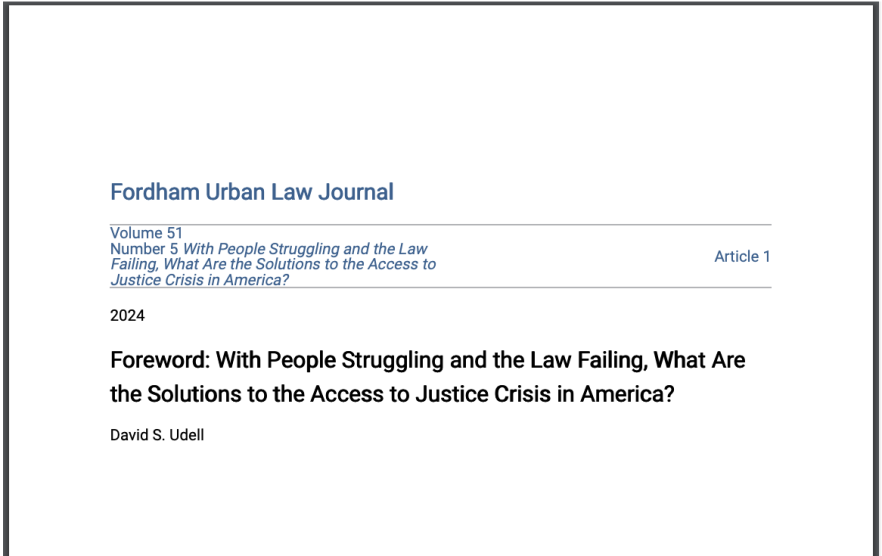
Cover of NCAJ's Symposium Foreword

New Writings Describe Policy Solutions at the Leading Edge of the Access to Justice Movement

December 3, 2024
In eight new articles arising out of the Access to Justice Solutions Symposium, the public event hosted by NCAJ on February 9, 2024 in partnership with the Stein Center for Law & Ethics and Fordham's Urban Law Journal, scholars and advocates now discuss and analyze important policy solutions at the leading edge of the access to justice movement.
Read More
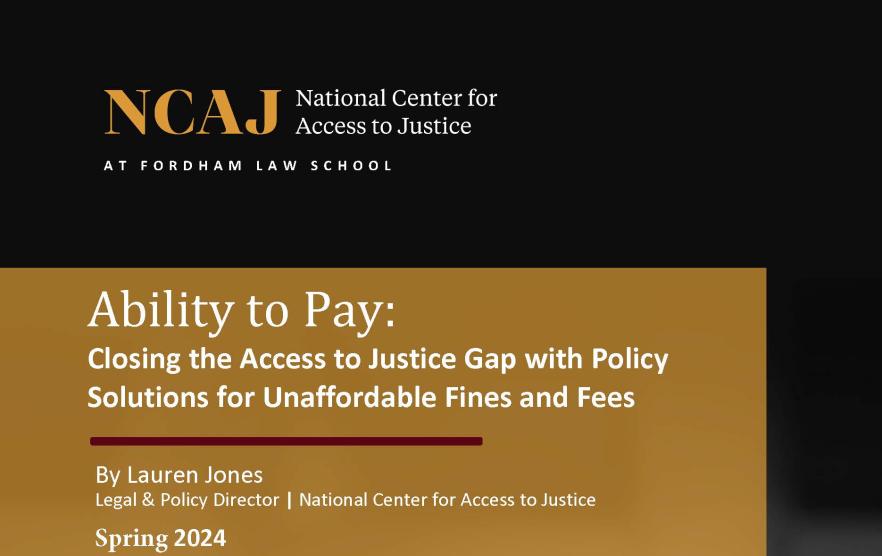
Cover of Ability to Pay Report

NCAJ's Ability to Pay Report & NCAJ's New Law Journal Article on Ability to Pay are Live Online

October 6, 2024
Government imposed fines and fees can add up to thousands of dollars. People able to pay can close their cases quickly and move on with their lives. However, people unable to pay face a wide range of harms. It shouldn’t be this way. Meaningful ability to pay determinations can reduce these harms and create greater equity.
Read More

Watch the Videos from NCAJ's Access to Justice Solutions Symposium of February 9, 2024

March 12, 2024
On February 9th, 2024, more than 500 peopled gathered or tuned in via stream to the AtJ Solutions Symposium. The sessions were videotaped that day. If you'd like to re-see what you saw, or see the sessions for the first time, you can do so at the links, below. Take a look, consider the progress of the access to justice movement, and join in the work to increase access to justice in America.
Read More

Pagination

  • Page 1
  • Next page Next ›
Subscribe to National Center for Access to Justice News Feed

Sign up for updates

Email
ncaj@fordham.edu
Address

150 West 62nd Street,
Suite 7-165,
New York, NY 10023
United States

Follow NCAJ on social media

  • Facebook
  • Twitter

©2026 NCAJ | Accessibility Statement