
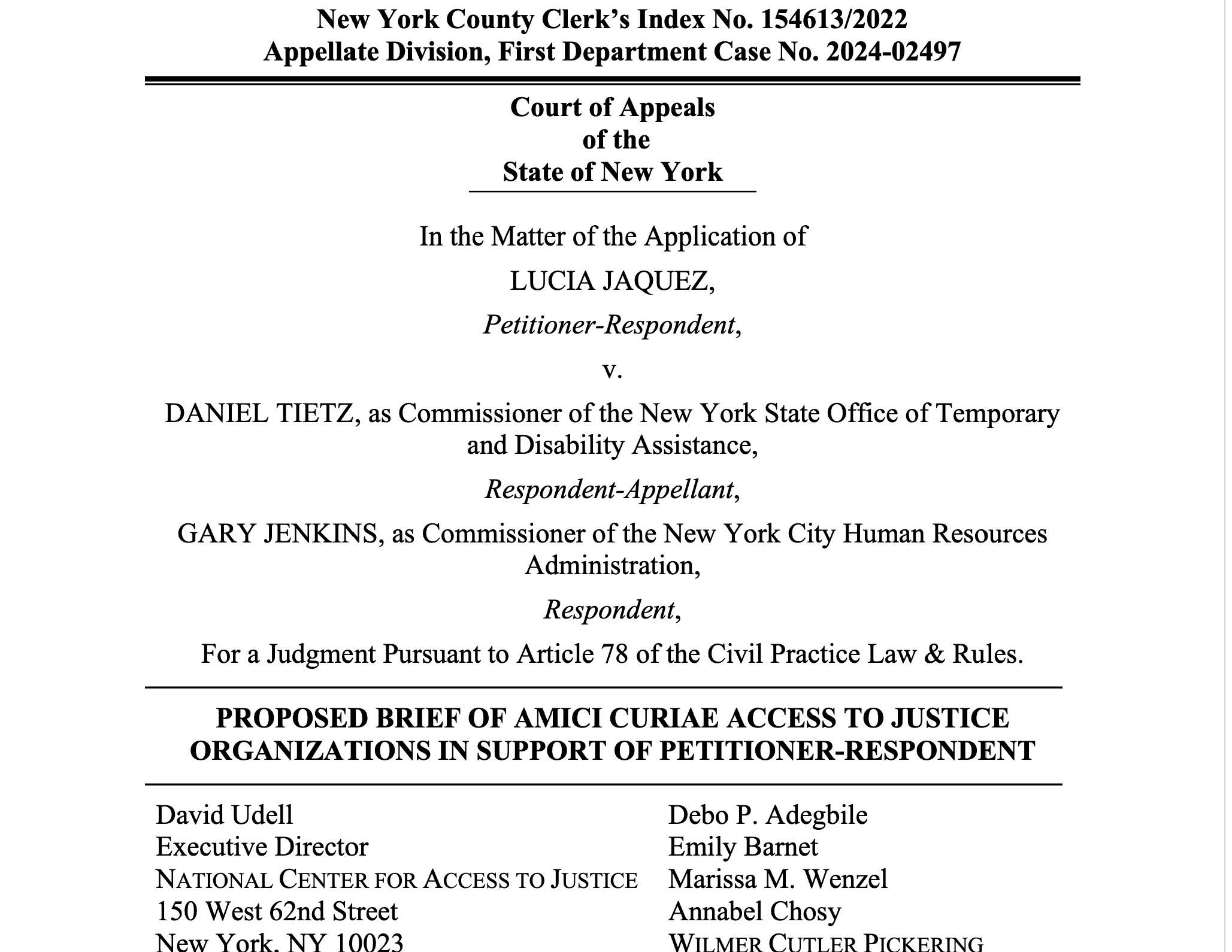
This past week, NCAJ co-authored with WilmerHale a proposed amicus brief in Matter of Jaquez v. Tietz on behalf of NCAJ and two fellow amici. The brief urges New York's highest court to preserve the “catalyst theory” under New York's Equal Access to Justice Act (EAJA).
Under the catalyst theory, a party may claim and recover attorneys’ fees under EAJA when the filing of a lawsuit serves as the catalyst that prompts the government to correct an agency error and provide the requested relief before a court reaches and decides the case on the merits. In the Jaquez case, the government had unlawfully withheld $7,000 it owed to Ms. Jaquez. Her lawsuit served as the catalyst that caused the government to promptly correct its error, apply the proper law, and release the funds.
The amicus brief explains how EAJA supports access to justice by making representation more available to people challenging unreasonable government action. Catalyst fees are critical to EAJA's purpose because, without them, the government could avoid fee liability by correcting its error after suit is filed, making lawyers less likely to take similar cases in the future. The brief further explains that the value of representation is not only access, but also what access accomplishes: correction of the government's errors of law, and creation of incentives to reduce such errors by government in future cases. In these ways, the amicus brief highlights the importance of catalyst fees in promoting the rule of law.
NCAJ is grateful to the WilmerHale firm for its role in co-authoring the amicus brief and also grateful to participate alongside two fellow amici, the Feerick Center for Social Justice at Fordham Law School and the Center on Civil Justice at NYU School of Law. For additional background, check out our joint press release.